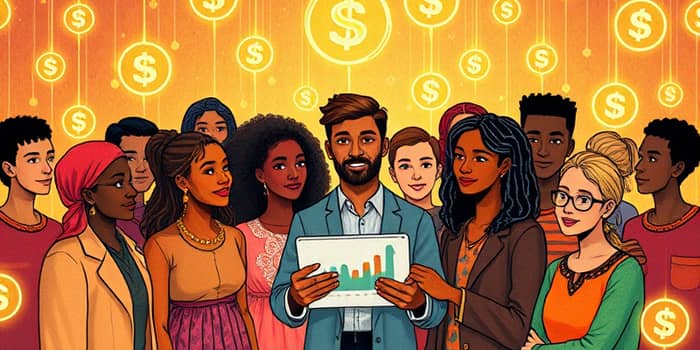
In a world where financial inclusion has become a hallmark of equitable growth, countless individuals stand at the margins—fully capable of building brighter futures yet unseen by conventional credit gatekeepers. For underwriters, this uncharted territory is not a risk to sidestep but a frontier ripe with promise. Shifting perspective from what credit seekers lack to what they can achieve unlocks new possibilities. Today’s forward-looking lenders hold the power to bridge divides, champion opportunity, and drive meaningful change.
Imagine families securing their first home, entrepreneurs scaling businesses, and students financing education—all because an underwriter peered beyond a thin file to discover potential in everyday actions. This shift demands more than tools; it requires a philosophy that values each individual’s story. By weaving together advanced analytics, personal insight, and thoughtful governance, financial institutions can craft experiences of trust, efficiency, and genuine partnership. The journey toward inclusive credit begins with a single decision to open doors.
The Underserved Opportunity
Approximately 13% of adult Americans are underbanked, and 6% are completely unbanked. Over 62 million people have thin or non-existent credit files, and 45 to 60 million lack sufficient history for reliable scores. A 2016 study found more than 10 million mortgage-ready buyers went underserved by 2019. These gaps represent not only a moral imperative but also a $1.5 trillion market opportunity.
Recognizing this potential requires a shift from risk avoidance to strategic inclusion. Underwriters equipped with data-driven tools can identify creditworthy candidates among individuals with limited traditional histories.
- Unbanked and underbanked households
- Consumers with thin or no credit files
- First-time loan and credit card applicants
- Credit-invisible individuals
- Mortgage-ready homebuyers overlooked by legacy models
Despite their creditworthiness, these borrowers often face higher costs or complete denial due to incomplete data. Legacy underwriting approaches create invisible barriers, reinforcing cycles of financial stress. Embracing inclusive strategies not only meets an underserved need but also fosters community resilience and loyalty. By recognizing the humanity behind each application, lenders can cultivate trust and build sustainable pipelines of responsible borrowers.
Harnessing Alternative Data and AI
Today, 59% of lenders incorporate new data streams into their underwriting. By integrating innovative alternative data solutions for underwriting, financial institutions can build more complete borrower profiles. Common sources include bank transaction data, income verification, utility and rent payments, behavioral metrics, and digital platform footprints.
AI and machine learning enhance these efforts by delivering comprehensive, automated risk analysis with AI. They detect patterns across thousands of variables, forecast performance, and surface subtle signals that human reviewers might miss.
- Cash flow and bank transaction records
- Employment and income verification data
- Utility and rent payment histories
- Digital and social platform behavior
- Anonymous metadata and spending patterns
Advanced AI platforms offer significant predictive performance improvements and accuracy, outperforming manual processes in default prediction and fraud detection. Explainability features ensure every decision is transparent, with document citations, confidence scores, and natural language rationales. This blend of power and clarity helps satisfy regulators, underwriters, and consumers alike, setting the stage for scalable, ethical underwriting frameworks.
A Balanced Approach to Innovation
While technology unlocks vast potential, human judgment remains invaluable, especially for complex commercial loans. Top performers adopt a balanced approach to AI and human oversight. They automate high-volume tasks, apply confidence scoring to route borderline cases, and preserve expert review for nuanced decisions.
Case studies reveal lenders adopting this model see up to a 20% increase in approval rates and a 15% reduction in delinquency. These gains underscore the value of pairing machine speed with human empathy. Training programs that familiarize staff with AI outputs ensure seamless collaboration and continuous learning, reinforcing both accuracy and trust.
Building Robust Data Governance
Sustaining improved performance requires strong governance. Establish clear standards for data intake, validation, and ongoing monitoring. By implementing robust data governance frameworks for compliance, organizations safeguard accuracy and regulatory alignment over time.
- Defined data quality standards and audit trails
- Regular validation of extracted information
- Continuous performance monitoring and retraining
- Automated compliance checks integrated into workflows
Ongoing governance is not a one-time task. Establish cross-functional committees, invest in training, and schedule periodic audits. By measuring outcome metrics—such as default rates, approval consistency, and compliance findings—organizations can refine models, update policies, and maintain a cycle of continuous improvement. This proactive stance cements long-term success.
Regulatory Strategies for Lasting Impact
Policy plays a critical role in shaping inclusive credit markets. Industry leaders advocate for opt-in consumer access to non-traditional data and pilot programs to test new rules. Incentives for data submission to credit bureaus, nationwide privacy protections, and full digitization of records can create fairer, more efficient systems.
Collaboration between regulators, industry groups, and consumer advocates can shape policies that balance innovation with protection. Pilot projects can validate new metrics, while consumer education programs demystify alternative data benefits. With aligned incentives and clear standards, the financial ecosystem can evolve responsively, ensuring that technology enhances fairness rather than undermines it.
A Call to Action for Lenders
The era of missed opportunities is ending. By harnessing alternative data, AI, and strong governance, lenders can drive financial inclusion while capturing significant new revenue streams. Embrace this moment to pioneer change, foster trust, and transform lives.
Every loan approved under this new paradigm represents not just profit but a story of empowerment. When underwriters embrace change, they ignite possibilities—families building homes, entrepreneurs expanding ventures, individuals realizing dreams. The underwriter’s edge is not just a tool; it is a catalyst for collective progress.
With every innovative step, underwriters edge closer to a future where credit is truly accessible, risk is more accurately managed, and communities thrive together. Now is the time to seize the underwriter’s edge and champion a brighter, more inclusive tomorrow.
References
- https://www.novacredit.com/corporate-blog/research-finds-majority-of-lenders-now-use-alternative-data-in-underwriting
- https://www.v7labs.com/blog/ai-commercial-loan-underwriting
- https://m2pfintech.com/blog/steps-in-credit-underwriting-why-using-an-alternative-source-of-data-and-behavior-metrics-will-be-of-help/
- https://defisolutions.com/answers/credit-underwriting-the-ultimate-guide-for-lenders/
- https://kmgus.com/blog/the-untapped-potential-of-data-analytics-in-underwriting/
- https://www.vergentlms.com/best-practices-for-lenders-2025/
- https://msb.georgetown.edu/news-story/research-and-insights/georgetown-study-reveals-potential-credit-resolutions-for-the-unbanked-and-underbanked/
- https://homeownershipcouncil.org/the-untapped-potential
- https://singlefamily.fanniemae.com/originating-underwriting/loan-quality/quality-insider/september-2025
- https://www.ncontracts.com/nsight-blog/best-practices-for-a-better-lending-compliance-program
- https://www.fdic.gov/bank-examinations/underwriting-trends-and-other-highlights-fdics-credit-and-consumer
- https://ncua.gov/regulation-supervision/letters-credit-unions-other-guidance/ncuas-2025-supervisory-priorities
- https://materialize.com/blog/loan-underwriting-big-data-sql/
- https://www.federalreserve.gov/data/sloos/sloos-202507.htm
- https://www.monitordaily.com/opinion/ai-automation-the-future-of-underwriting/