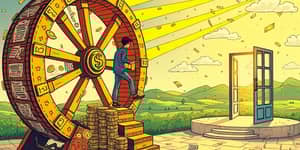
In an era defined by the relentless pursuit of growth, the concept of a steady-state economy offers a transformative vision: an economy designed for stability, resilience, and genuine well-being. By embracing this model, societies can foster enduring harmony between humans and nature.
Foundations of the Steady-State Economy
The notion of a steady-state economy originates from classical economists of the 18th century but gained modern clarity through the work of Herman Daly. He defines it as an economy maintaining constant stocks of capital and population, supported by the lowest feasible flows of matter to meet needs without depleting our planet’s bounty.
Unlike traditional models that hinge on perpetual expansion, a steady-state approach emphasizes equilibrium. It recognizes that Earth’s resources are finite and that unchecked growth can lead to ecosystem collapse, social inequities, and economic instability.
Core Principles and Framework
At its heart, the steady-state economy adheres to four fundamental rules that guide every decision, from resource extraction to waste management. These rules ensure we operate within ecological limits and secure a stable future.
- Maintain the health of ecosystems and life-support services.
- Extract renewable resources at or below regeneration rates.
- Consume non-renewables only at substitution replacement pace.
- Deposit wastes no faster than the environment can assimilate.
Key Features That Distinguish Stability
Beyond its guiding rules, a steady-state economy is characterized by four essential features that set it apart from growth-centric systems:
- Sustainable scale that respects planetary boundaries.
- Stable population size and consumption throughput.
- An ecological limits focus over endless GDP growth.
- Quality of life priority above short-term gains.
Institutional Pillars for Implementation
To transform theory into practice, Daly proposes three institutional pillars that overlay market mechanisms. They form a superstructure ensuring equity, ecological integrity, and controlled throughput.
Practical Policy Tools
A steady-state economy can leverage familiar policy instruments in innovative ways, ensuring stability without stifling innovation.
- Fiscal policy tools like strategic taxation and public investment.
- Monetary policy adjustments, including money supply controls.
- Institutional shifts, such as transitioning to fee-based banking.
Crucially, permanent absolute limits on extraction, use, and pollution create urgency for efficiency and recycling, rather than relying solely on price mechanisms.
Debunking Common Misconceptions
Myth: A non-growing economy must collapse. Reality: A system built for stability eliminates boom-and-bust cycles, providing consistent well-being.
Myth: Steady-state equals socialism. Reality: It retains a mix of private and public ownership, using market structures for allocation while reserving vital ecological limits for democratic control.
Outcomes for Quality of Life and Sustainability
Adopting a steady-state model can yield profound benefits. By focusing on long-term ecological health and enough as a guiding goal, societies can achieve:
- Higher overall well-being through reduced inequality.
- Continuous innovation in technologies rather than endless scale expansion.
- Greater resilience to shocks like droughts or energy disruptions.
Employment remains stable, though it evolves with changing development priorities. By capping throughput per worker and extending retirement ages, job opportunities can expand meaningfully.
Ultimately, the steady-state economy represents a radical reimagining of progress, one that ensures prosperity within the planet’s ecological boundaries. It invites us to choose balance over excess, community over competition, and long-term health over fleeting gains.
Now is the moment to champion policies that limit extraction, prioritize equity, and foster innovation without jeopardizing our future. By embracing the steady-state path, we can secure a world where financial harmony and environmental stewardship walk hand in hand.
References
- https://steadystate.org/discover/definition-of-steady-state-economy/
- https://en.wikipedia.org/wiki/Steady-state_economy
- https://mahb.stanford.edu/blog/steady-state-economics-in-a-world-of-resource-limits-a-mahb-dialogue-with-environmental-economist-rob-dietz/
- https://populationmatters.org/news/2024/10/balancing-act-how-the-steady-state-economy-seeks-equilibrium/
- https://esg.sustainability-directory.com/area/steady-state-economics-principles/
- https://econation.one/steady-state-economy/