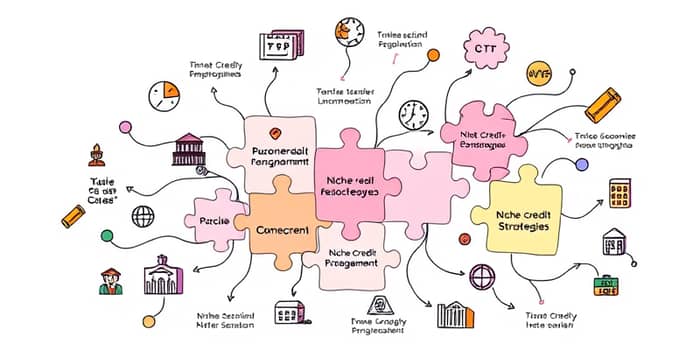
In today's fast-paced financial world, the search for higher yields and robust downside protection has never been more critical.
Traditional investments like stocks and bonds often leave portfolios exposed to market volatility and low returns.
This is where specialized credit strategies step in, offering diversification from traditional assets and unique opportunities in overlooked markets.
Unlocking the Power of Specialized Credit
Specialized credit investment strategies focus on niches within private and distressed credit markets.
They aim to deliver enhanced performance by targeting assets that are often complex or undervalued.
By integrating these approaches, investors can achieve improved risk-adjusted returns and better portfolio resilience.
These strategies thrive on identifying mispricings and capitalizing on market dislocations.
From special situations to structured products, each niche offers a distinct path to financial growth.
Understanding the Risk-Return Spectrum
Specialized credit strategies are positioned along a risk and return continuum that guides investment decisions.
At one end, strategies like direct lending emphasize capital preservation and stable income.
At the other, distressed credit focuses on high upside potential and capital appreciation.
This spectrum allows investors to tailor their approach based on individual goals and risk tolerance.
It ensures that every portfolio can find its sweet spot in the credit universe.
- Capital preservation strategies: Senior debt, asset-based lending.
- Return maximization strategies: Distressed credit, mezzanine financing.
- Balanced approaches: Opportunistic credit, specialty finance.
Key Strategy Categories for Modern Investors
The landscape of specialized credit is rich with diverse options, each with unique characteristics.
Here is a table summarizing the major categories to help you navigate this complex field.
This table provides a comprehensive overview of niches to help you make informed choices.
Each category offers a unique blend of risk and reward, tailored to different investor profiles.
Enhancing Portfolio Performance
Integrating specialized credit into your portfolio can lead to significant improvements.
Allocations of 10-40% to special situations credit, when added to a traditional 60/40 stock/bond mix, boost efficiency.
This approach enhances risk-adjusted returns and diversification benefits beyond conventional assets.
- Yield advantages: Private credit offers 100-200 bps over public leveraged finance.
- Diversification: Low correlation to equities reduces overall portfolio volatility.
- Tailoring strategies: Mix senior debt for income, credit opportunities for upside, and specialty finance for uncorrelated assets.
For example, a portfolio with 55% stocks, 35% bonds, and 10% special situations often outperforms traditional mixes.
This demonstrates the power of strategic allocation in achieving better financial outcomes.
Seizing Opportunities for Alpha
The current market environment is ripe with opportunities for specialized credit investors.
Higher interest rates boost floating-rate assets, making strategies like structured credit more attractive.
Market inefficiencies, such as dislocations post-stress, create relative value across public and private markets.
- Active approaches: Sector rotation and structural alpha from data models.
- Fintech growth: Non-bank lenders fill gaps, offering niche lending opportunities.
- Downturn positioning: Distressed credit strategies thrive in liquidity crunches.
By staying agile and informed, investors can capitalize on these tailwinds for sustained growth.
Navigating Risks and Practical Considerations
While specialized credit offers many benefits, it's essential to be aware of the risks involved.
Complexity requires expertise in credit analysis and structures, making manager selection crucial.
Liquidity can be a concern, with many strategies involving illiquid assets, though short-duration options exist.
- Skewness: Capital preservation strategies may have negative skew, while distressed credit shows positive skew.
- Portfolio role: Use as a satellite allocation to complement core holdings like private equity or fixed income.
- Implementation: Focus on diversified portfolios and active management to mitigate risks.
Understanding these factors helps in building a resilient and effective investment plan.
Practical Steps to Get Started
Embarking on specialized credit investing doesn't have to be daunting.
Start by assessing your risk tolerance and financial goals to identify suitable strategies.
Research and select experienced managers who have a proven track record in niche markets.
- Education: Learn about different strategy categories through resources and expert insights.
- Diversification: Begin with small allocations to test the waters and gradually expand.
- Monitoring: Regularly review performance and adjust strategies based on market conditions.
By taking these steps, you can confidently integrate specialized credit into your portfolio for long-term success.
Remember, the journey to finding your niche is about continuous learning and adaptation in a dynamic financial landscape.
References
- http://www.destracapital.com/about/insights/what-special-situations-credit-investing
- https://www.brigadecapital.com/strategies
- https://www.cambridgeassociates.com/insight/private-credit-strategies-introduction/
- https://www.pimco.com/us/en/insights/active-management-comes-for-private-credit-in-depth-investment-approaches
- https://www.cambridgeassociates.com/insight/specialty-finance-investing-a-versatile-tool-for-private-credit-investors/
- https://www.optoinvest.com/insights/what-are-different-private-credit-strategies
- https://www.hamiltonlane.com/en-us/strategies/direct-credit-investments
- https://icapital.com/insights/hedge-funds/exploring-different-credit-hedge-fund-strategies/
- https://carta.com/learn/private-funds/private-equity/strategies/private-credit-investing/
- https://privatebank.jpmorgan.com/nam/en/services/investing/alternative-investments/private-credit-investing
- https://www.nb.com/en/us/insights/whitepaper-specialty-finance-high-yielding-short-duration-and-uncorrelated-private-credit
- https://www.morganstanley.com/im/en-la/intermediary-investor/strategies/private-credit-and-equity/private-credit.html